
Rocket propulsion technologies have revolutionized space exploration, pushing the boundaries of what humanity can achieve beyond our planet. From the early days of rudimentary engines to today’s sophisticated systems, these technologies are at the heart of every successful mission into space. They harness the power of physics to propel spacecraft, making interstellar travel a tangible goal.
As the demand for space exploration grows, so does the need for innovative propulsion methods. Engineers and scientists are continually developing advanced technologies, such as ion propulsion and reusable rocket systems, to increase efficiency and reduce costs. Understanding these technologies is crucial for anyone interested in the future of space travel and the possibilities it holds for exploration and discovery.
Overview of Rocket Propulsion Technologies
Rocket propulsion technologies encompass various methods utilized to generate thrust for vehicles moving in space. These technologies fall into primarily two categories: chemical propulsion and non-chemical propulsion.
Chemical Propulsion
Chemical propulsion relies on the combustion of propellants to produce high-pressure and high-temperature gases. This method generates thrust through Newton’s third law of motion. Key systems under this category include:
- Solid Rocket Motors: Composition consists of a solid propellant mixture. They are simple, reliable, and typically used in booster stages.
- Liquid Rocket Engines: These engines use liquid propellants stored separately. They offer better control of thrust and are used in major space launch vehicles.
- Hybrid Rocket Motors: A combination of solid and liquid propellants. They provide advantages of both types, including throttling capability and simplified design.
Non-Chemical Propulsion
Non-chemical propulsion technologies utilize other means to create thrust, enhancing efficiency over chemical methods. Some types include:
- Electric Propulsion: This method employs electric or magnetic fields to accelerate ions. Notable systems include ion thrusters and Hall-effect thrusters, suitable for deep-space missions due to their high efficiency.
- Nuclear Thermal Propulsion: A nuclear reactor heats a propellant, which then expands and is expelled to produce thrust. This technology promises high performance for crewed missions to Mars and beyond.
- Solar Sails: These systems use sunlight pressure to propel spacecraft. By harnessing solar radiation, they offer a continuous thrust without needing fuel, making them ideal for long-duration missions.
Advancements in Rocket Propulsion
Recent innovations in propulsion technologies focus on improving efficiency, reducing costs, and enhancing reliability. Reusable rocket systems, such as SpaceX’s Falcon 9, significantly decrease launch expenses by allowing rockets to return for refurbishment and reuse. Furthermore, developing green propellants reduces environmental impact while maintaining performance.
Understanding these diverse propulsion methods and their advancements fosters progress in the field of space exploration, highlighting the ongoing quest for effective and sustainable travel methods beyond Earth.
Types of Rocket Propulsion
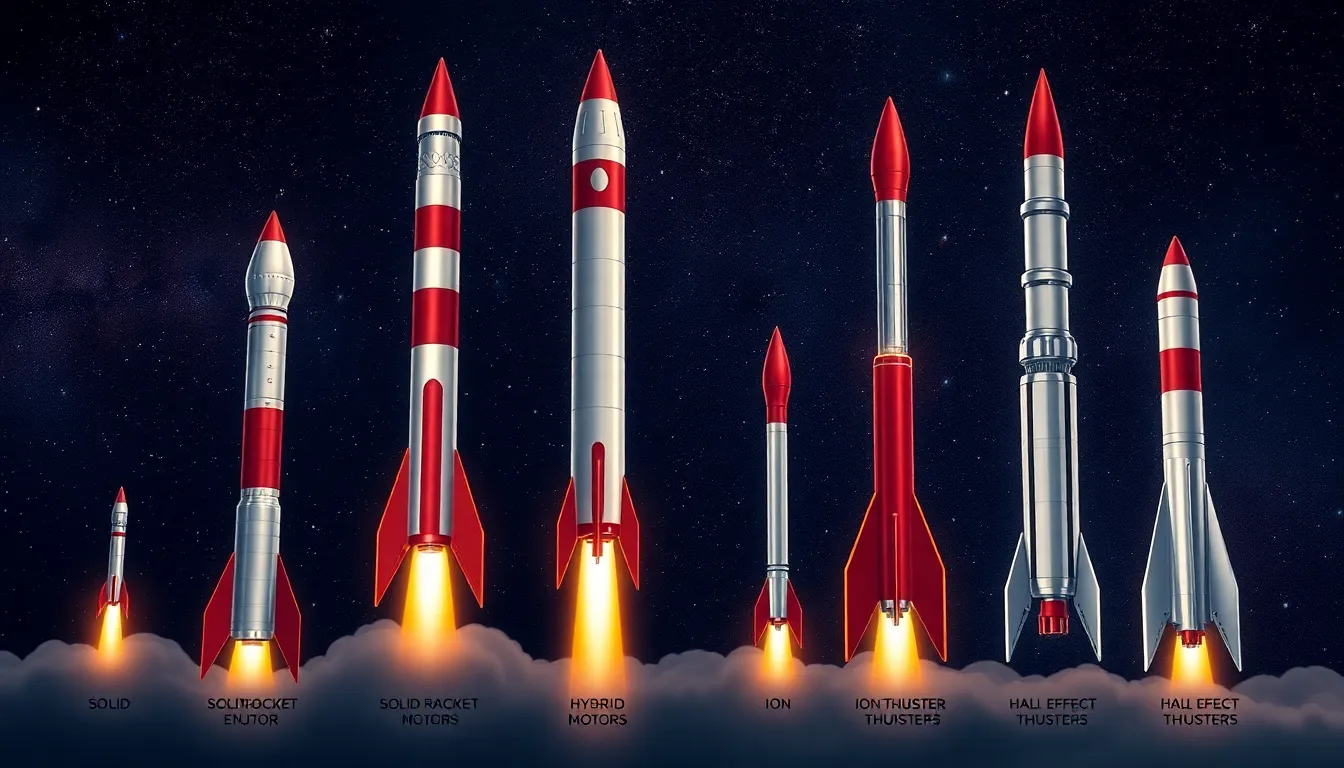
Various rocket propulsion technologies exist, each designed to meet specific mission requirements and enhance efficiency. Here’s a closer look at the primary types of propulsion systems.
Chemical Propulsion
Chemical propulsion relies on the combustion of propellants to generate thrust. The main systems include:
- Solid Rocket Motors: These systems contain propellant in a solid state. Combustion occurs within a combustion chamber, producing high-pressure gases that exit through a nozzle, creating thrust. Solid rocket motors are simple and reliable, commonly used in boosters and missiles.
- Liquid Rocket Engines: These engines use liquid propellants that are stored in tanks, pumped into a combustion chamber, and ignited to produce thrust. Liquid engines provide greater control over thrust levels, making them suitable for various missions, including orbital launches.
- Hybrid Rocket Motors: Hybrid motors combine solid and liquid propellants. Typically, a solid fuel burns while a liquid oxidizer is injected. This design offers the simplicity of solid fuels with some controllability of liquid engines, making hybrid systems an attractive option for certain applications.
Electric Propulsion
Electric propulsion utilizes electrical energy to accelerate propellant for thrust. Noteworthy systems include:
- Ion Thrusters: These devices ionize propellant (often xenon) and use electric fields to accelerate the ions, producing thrust. Ion thrusters achieve high specific impulse but require long operational times. They excel in deep-space missions, where efficiency is critical.
- Hall Effect Thrusters: Similar to ion thrusters, Hall effect thrusters use magnetic fields to increase the efficiency of ion acceleration. These systems offer robust performance in Earth orbit and are employed in satellites for station-keeping and orbital maneuvers.
Hybrid Propulsion
Hybrid propulsion incorporates elements of both chemical and electric systems. Key aspects include:
- Flexible Operating Modes: Hybrid engines can switch between different propulsion methods, optimizing performance based on mission requirements. This adaptability allows for greater versatility in applications.
- Diverse Propellant Options: By combining solid and liquid fuels or integrating electric options, hybrid systems can leverage the advantages of various propellants. This leads to enhanced efficiency and reduced environmental impact.
These propulsion types contribute to the advancements in space exploration technologies, catering to diverse needs in missions from low Earth orbit to deep space.
Key Components of Rocket Propulsion Systems
Rocket propulsion systems consist of various critical components essential for effective thrust generation. These components include propellants, nozzles, and engine design, each playing a unique role in the overall functionality of a rocket.
Propellants
Propellants are the fuel sources that drive rocket engines. They fall into two categories: chemical and non-chemical propellants. Chemical propellants involve the combustion of fuels like liquid hydrogen and oxygen or solids like ammonium perchlorate. Liquid propellants enable precise thrust adjustments, enhancing mission flexibility. Non-chemical propellants, such as those used in electric propulsion systems (e.g., ion thrusters), rely on electrical energy to produce thrust, making them suitable for long-duration space missions. Each type of propellant offers distinct advantages, impacting efficiency and performance.
Nozzles
Nozzles are crucial for converting thermal energy from propellant combustion into kinetic energy. Different nozzle designs, such as converging, diverging, or bell-shaped configurations, affect the expansion and acceleration of exhaust gases. These designs optimize thrust during flight. Variable-area nozzles allow for adjustments in exhaust flow, catering to various flight regimes and improving overall efficiency. Effective nozzle design maximizes the rocket’s propulsion capability, ensuring peak performance during launch and ascent.
Engine Design
Engine design encompasses multiple components, including combustion chambers, turbopumps, and igniters. The combustion chamber ignites and burns the propellant, while turbopumps transfer propellant to the combustion chamber. Ignition systems vary from spark igniters to hypergolic reactions, where propellants ignite spontaneously. Advanced engine designs may integrate active cooling systems to manage thermal loads, enhancing reliability and performance. Understanding these design elements is vital for optimizing rocket efficiency, ensuring successful missions and sustainability in space exploration.
Future Trends in Rocket Propulsion Technologies
Innovations and sustainable practices shape the future of rocket propulsion technologies. The emphasis on advanced materials and eco-friendly solutions leads to more efficient systems and a reduced environmental footprint.
Innovations in Materials
Innovative materials play a crucial role in the evolution of rocket propulsion technologies. Lightweight composites, like carbon fiber reinforced polymers, enhance structural integrity while minimizing weight. Heat-resistant ceramics withstand extreme temperatures, improving engine performance during re-entry and launch. Metal alloys, such as titanium and aluminum, provide durability and reliability in critical components. Moreover, advancements in additive manufacturing, or 3D printing, allow for complex designs that reduce manufacturing time and costs while increasing performance efficiency. These new materials contribute to enhanced safety and reduced overall mission costs.
Sustainable Propulsion Solutions
Developing sustainable propulsion solutions addresses environmental concerns while maintaining performance. Green propellants, such as LMP-103S, offer lower toxicity and improved safety compared to traditional options. Electric propulsion technologies, like ion drives, utilize electrical energy for efficient thrust, significantly reducing propellant consumption during deep-space missions. Additionally, researchers are exploring hybrid systems that combine conventional chemical fuels with alternative, eco-friendly methods to optimize performance while minimizing emissions. These sustainable strategies promise to lower the environmental impact of future space missions and promote the long-term viability of space exploration initiatives.
Rocket propulsion technologies are at the forefront of space exploration and innovation. The advancements in both chemical and non-chemical methods pave the way for more efficient and sustainable missions. As the industry evolves it’s crucial to embrace new ideas that enhance performance while addressing environmental concerns.
The shift toward reusable systems and green propellants showcases a commitment to reducing costs and emissions. With ongoing research and development in propulsion technologies the potential for future discoveries in space remains limitless. The journey toward exploring the cosmos continues to inspire and challenge engineers and scientists alike.